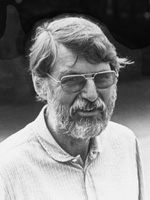
photo by Laki Vazakas
Robert Creeley
May 21, 1926 - March 30, 2005
Robert Creeley wrote poetry with a spare minimalism that clarified, condensed and dissolved the distance between thought and feeling, between the real world and the imagined, between language and meaning. He was often more explicit than Samuel Beckett and much more approachable, but no less dense or elusive. — Jan Herman
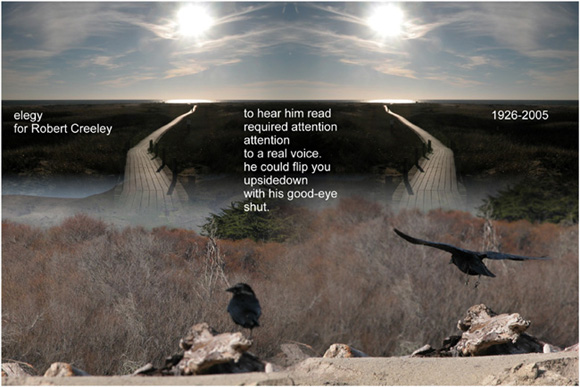
And when a poet dies, deep in the night,
a lone black bird wakes up in the thicket
and sings for all it's worth...
-- M. Holub. From, "Interferon."
poem/collage by Eero Ruuttila
One of America's most celebrated poets and for more than half a century a leading figure in the literary avant-garde, Robert Creeley entered Harvard Univ. in the fall of 1943, and leaving after one year to drive an ambulance in the India-Burma theatre of World War II. Returning to Harvard in 1945 he helped edit Harvard Wake, no. 5, a special E. E. Cummings issue, in which his first published poem, Return appeared. He was also an editor of the Black Mountain College literary journal, the Black Mountain Review.
Form is never more than an extension of content.
-- Robert Creeley