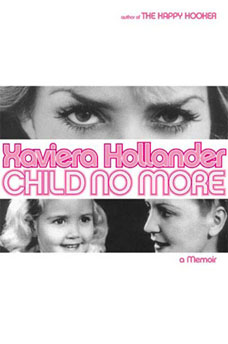
In 1941, the intellectual Jewish psychiatrist Mick de Vries met Germaine Schluetter, a German-born model, at a party in Amsterdam and knew immediately that he was going to marry her. Within a month, they were honeymooning at St. Moritz, and soon after, they moved to Indonesia, where they hoped to be safe from the war and the anti-Semitism that was growing in Europe. However, two months after the birth of their only child, Xaviera, the young family was divided - the mother and daughter at one Japanese prison camp and the father at another.
Though she and her parents survived, memories of those terrible days haunted each of them in different ways for years to come. Reunited at last, the family moved to Holland to escape further violence in Indonesia. As they resettled into life, Xaviera began to learn more about her parents as a couple. Tender and loving at some times, bitterly angry at others, they kept their daughter curious about the nature of intimacy. She fell in love with her handsome and charismatic father, and struggled with her mother's strict and forceful ways. But as time passed she realized her father's imperfections, came to understand her mother's fears, and began to learn more about herself as a woman. The role that sex would come to play in her life was established early, and Hollander traces how the lives of her extraordinary parents intertwined with her own sexual explorations. At the same time, she reviews the friendships and romances of her inner life — not her professional one. Readers familiar with Hollander's writing will recognize the breathtaking frankness of her observations.
This is the true story of the woman behind the myth — and of her parents, a Dutch Jewish doctor in Indonesia and a glamorous German model, and of their struggle to survive and to protect their child behind the barbed wire of Japanese prisoner camps. As a baby, Xaviera grew up in a surreal world of torture and death — and from there, what a contrast to adolescence in her bohemian yet bourgeois family home in post-war Amsterdam.
Breaking out from the comfortable world of writers and artists, physicians and psychologists, she found defiant self-expression in New York. Out of the taboo world of sex, The Happy Hooker was born. Yet, even at her moments of most flagrant revolt, beneath the mask of Xaviera Hollander, there lived Xaviera de Vries, the child who desperately wanted to prove herself to her parents.
She knew that she caused them anguish: her ambition was that they would become proud of her and of what she would ultimately achieve. Her father did not live to see the transformation of Xaviera from the rebel who dared to tear the veil of hypocritical prudery from sex into the most successful producer of English language drama in Holland but her mother survived to rejoice in this new career of Xaviera.
This book is a memorial of a loving daughter to her mother, to whose memory it is dedicated. It is an honest record of suffering and of death, but overwhelmingly it is an account of life and of love, and amid the tears, there is much laughter.
Here is the same frankness that made The Happy Hooker such a sensation but this book exposes the raw emotions, the triumphs and tribulations of parents and daughter, three exceptional people.
© 2002. Used with permission - Xaviera Hollander (de Vries)