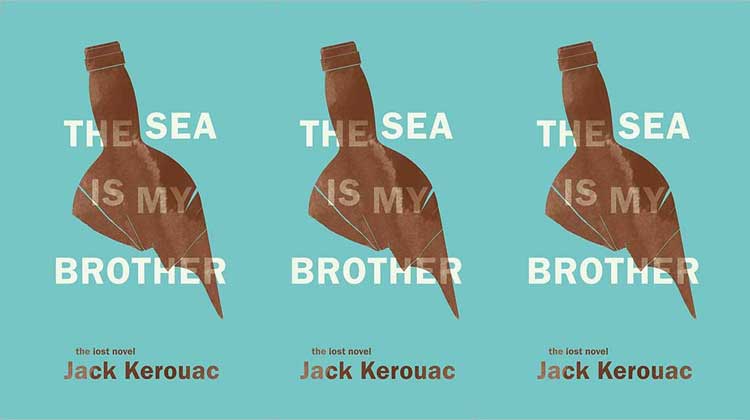
The Sea is My Brother was Jack Kerouac’s first attempt at a novel. Technically it fits the criteria of a novella, the original manuscript weighing in at 158 pages. Published for the first time in its entirety by Penguin Classics (2011) and bound together with other collected juvenilia, it is important to remember that this manuscript is exactly that, juvenilia. Penned by Kerouac in his twentieth year (1942) on return from his first and only tour as a merchant seaman on the S.S Dorchester, It charts in detailed recollection the significance of this experience upon the young writer.
The ‘lost novel’ provides an insight into the mind of a writer who became synonymous with autobiographical spontaneous prose, and who after gaining recognition with On the Road became a reluctant icon, a spokesman for the beat generation. This early work proves that Kerouac was honing his jazz rhythm spontaneity long before the fifties.
The Sea is My Brother is a story of friendship, brotherhood, and the relationship between man and sea. Wesley Martin, an accomplished sailor meets Bill Everhart, a Columbia University graduate turned professor. Martin is broke and washed up after squandering his money whilst on leave. After a chance meeting at a Broadway bar, the two men quickly become acquainted with the help of drink and women. In Martin, Everhart can see the experience and freedom that he secretly craves. Everhart decides to take a break from his teaching post and signs up with Martin to set sail. In many ways these two characters are opposites, and there are echoes of the relationship between Neal Cassady and Jack Kerouac, as immortalised in On the Road through the characters Dean Moriarty and Sal Paradise.
However, both characters Martin and Everhart display similarities to Kerouac himself. Kerouac acknowledges this in a journal comment on the novel. “Everhart is my schizoid self, Martin the other; the two combined run the parallel gamut of my experience.” These polar personalities can be considered as the manifestation of the young writer’s conflicting personality. Kerouac often implied that he felt alienated from the working man as a writer, yet separate from the academic as a university drop out and autodidact.
The theme of friendship, in particular male friendships are common to Kerouac’s work and this early piece acts as a blueprint in terms of style and themes, it also contains many of the subjects that were developed extensively in On the Road.
In this first attempt at a novel the sea substitutes the road that would become the antithesis of freedom in much of Kerouac’s later work, although it should be noted that the Westminster doesn’t actually ship out until two-thirds of the way through the novel. The implication of this is that ‘being at sea’ is a state of mind, that the very notion of being at sea is as significant as the physical act. The relationship that Martin has with the sea shapes the meaning of his existence. Kerouac suggests that it is a relationship that runs deep within, something that a man cannot shake off. “The sea was enough, was everything.”
Whilst this is not the most polished of Kerouac’s novels it is a fine indication of his passion and commitment as a writer. The sincerity and authenticity with which he approached his subject matter is admirable. Kerouac wrote what he knew, wrote from his experience, he wrote of the poetry that he saw in the ordinary. The Sea is My Brother reads like a preliminary sketch, an exercise in detailing the bigger visions; it is the sketch that first captures the essence of the subject, and this novel captures the essence of brotherhood and the sea. This is perhaps best summed up in the following passage. “…all those who passed under the arch of the door entered into the Brotherhood of the Sea – these men considered the sea a great leveller, a united force, a master comrade brooding over their common loyalties.”
Kerouac’s early work is a poetic account of life at sea, a solid if somewhat sketchy story from a writer who set out to write what he knew. “Into this book, The Sea is My Brother, I shall weave all the passion and glory of living, its restlessness and peace, its fever and ennui, its mornings, noons and nights of desire, frustration, fear, triumph and death…” In this he succeeded.