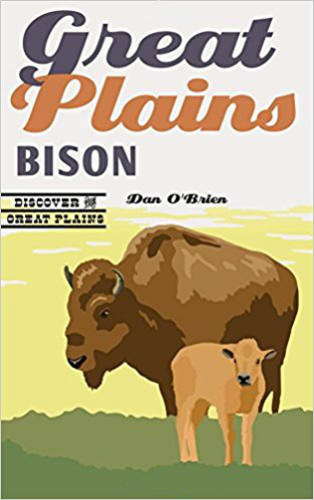
Great Plains Bison by Dan O’Brien / University of Nebraska Press / 2017 / xiii + 111pp /
Despite its variety in form, length, and genre, most writing seeks to explain why. Now, more than ever, we find ourselves searching for answers, yearning to explain how America could reach such dire straits—politically, racially, environmentally. In response, many writers have offered up their theories and perspectives on how we’ve arrived at this moment. Dan O’Brien, writer, environmentalist, and bison rancher, adds his voice to this discussion in his new book, Great Plains Bison. O’Brien proposes that the American bison can be used as a framework to understand our nation’s past and present shortcomings. His thesis occurs early:
As soon as the number of buffalo began to diminish and their movement began to slow, the Great Plains began to change…Certainly a violent tragedy of betrayal occurred in the nineteenth century. But the nightmare continues. The drama is still being played out on one of the world’s largest stages, and through it all, the buffalo have been both actors and audience” (14).
O’Brien takes the reader on a vital and complex journey through the heaving formation of North America, the bison’s reign, the creature’s demise, and the bison’s contemporary struggles.
This is our national legacy. Though these claims are crucial to understanding the history and identity of the Plains, the disconnect and fragmentation O’Brien describes is relevant to our nation as a whole. One does not have to be a Plains scholar to understand and find resonance with his critiques of out-of-touch bureaucrats or the dastardly treatment of Native Americans. Though Great Plains Bison stays firmly rooted in South Dakota and the Great Plains, O’Brien’s musings on hard-hitting topics such as GMOs, environmentalism, and race relations assure that the work has national appeal.
Though the book points to many of America’s shortcomings, Great Plains Bison deftly exposes a country with an exasperatingly poor relationship with environmentalism. The history of the Great Plains is one of ecological rape and plunder. O’Brien provides a detailed account of Westward Expansion and the accompanying destruction of the bison and the fertile grasslands. Despite attempts by early conservationists to save the bison, American environmental law functioned as it does today: “laws were mostly lip service to appease the conservationists…none of the laws had provisions for effective enforcement, so the slaughter continued unimpeded” (59).
Perhaps the most heartbreaking part of O’Brien’s story is not the failure of legislation but the failure of those who crave change, those who hurt despite a desire to help. The history of the bison includes the story of William Hornaday, a taxidermist with a passion for preserving wild bison herds. With the goal of curating a bison-themed exhibit for the Smithsonian, Hornaday went on a bison hunt, killing 25 of the estimated 1,091 buffalo left. Though the exhibit helped spur interest in the imperiled species, O’Brien can’t help but note the irony of the man killing some of the last buffalo. O’Brien points out that this struggle continues. Contemporary efforts to restore bison populations often lead to feedlots and further exploitation of the animal. As the book concludes, O’Brien describes his ranch and his goals but ultimately does not seem hopeful for the bison’s future or proud of humanity’s current existence.
Great Plains Bison expertly incorporates research without feeling burdensome. O’Brien uses simple language and weaves together disparate sources to create a concise, linear narrative of the American bison. He doesn’t dwell on common knowledge (for example, giving only brief mention to Buffalo Bill) but doesn’t dive into esoteric history geared toward specialists. The book is refreshingly brief with compact, easily digestible chapters. O’Brien includes 20 images, ranging from maps to portraits of key players in the bison’s story. Unlike O’Brien’s other work, Great Plains Bison is not driven by personal narrative, making it a bit more objective in its storytelling. While it has the potential to appeal to a general audience interested in history, environmentalism, and/or the Great Plains, the book is most likely to find a home in the classroom and would serve as excellent supplemental reading for a variety of courses.
I found Great Plains Bison to be a compelling story that needed to be told. The book engages with the past but propels the reader into the future, reminding us that these are not bygone concerns. I finished this book with a healthy balance of indignation and satisfaction. By the time I finished reading, I felt I had learned something that mattered and that I had encountered a productive political treatise rather than been subjected to a belligerent manifesto. O’Brien encourages readers to reconsider what they know, to remember that most stories are incomplete, and to assume a perspective they’ve never considered before. He asks the reader to “feel a kind of innocence, tempered with confidence and power” and to assume “the thousand-yard stare of wisdom, patience, and endurance” (1). Above all, he asks readers to walk, for hundreds of years and millions of miles, in the footsteps of the American bison.